Seven years imprisoned despite innocent: The prosecution (and persecution) of the Mabinay 6
After seven long years, the so-called “Mabinay 6” are free.
The six student activists – Myles Albasin, Randel Hermino, Carlo Ybañes, Joemar Indico, Joey Vailoces, and Bernard Guillen – had been detained on charges of illegal possession of firearms and explosives but were acquitted by a trial court in Dumaguete City on Monday, 24 September.
The charges stemmed from an alleged “armed encounter” between the group and elements of the Armed Forces of the Philippines (AFP) in 2018. The military’s narrative portrayed the six youth activists as armed combatants of the New People’s Army (NPA) – a claim that lacked supporting evidence and corroborating eyewitnesses.
Despite serious suspicions against the claims, the Mabinay 6 remained behind bars for seven years until the court finally reached the same conclusion that many had long believed: they were innocent.
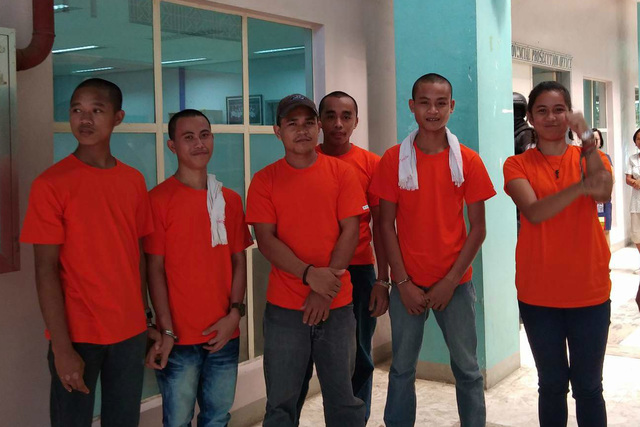
Their ordeal began in 2018, when the youth activists were conducting immersion activities among peasant communities in Mabinay, Negros Oriental. In the dead of night, soldiers surrounded the makeshift hut where they were sleeping and forcibly took the six into custody.
The Army’s 62nd Infantry Battalion (IB) claimed it had engaged the group in a firefight and later pursued them to the hut where the arrests were made. A subsequent search allegedly uncovered 12 firearms, ammunition, and explosives in their possession.
The military’s account could not be corroborated by local residents and village officials, who should have been woken up by the sound of gunshots and explosions if a firefight did occur. Instead, the military only presented their own soldiers and local police officers as witnesses who could support their narrative – and even those testimonies contradicted each other.
Soldier-witnesses claimed to have seized rifles, grenades, and even a landmine from the accused, yet none testified to seeing the activists fire any weapons. One of the arresting officers, Sgt. Leo P. Calderon, also admitted under oath that no grenades or explosives were used in the supposed firefight.
Perhaps most tellingly, all six activists tested negative in paraffin tests conducted days after the supposed encounter – undermining claims they had fired at the military. Factors such as barrel length, wind conditions, or even the use of gloves could explain individual negative results, but for all six detainees to return the same outcome was, in the words of the ballistics report summary, “incredible” unless no shots were fired at all.

The more plausible conclusion might be the latter, as the targeting of activists was rife under the regime of former president Rodrigo Duterte. Upon the arrest of the six youth activists, the 62nd IB said in a statement that they arrested “fully armed NPAs doing harassment and extortion activities” in Mabinay, Negros Oriental.
There had been a motive from the start to brand the six activists as armed rebel combatants, despite the contradicting evidence. In truth, the six were in Mabinay to organize a peasants’ forum as part of their advocacy work with peasant communities.
The Duterte regime faced mounting pressure from civil society groups, trade unions and student organizations over a myriad of issues it failed to address. By portraying its critics as guerrilla fighters, the regime made them enemies of the state – a narrative that allowed it to justify the use of military and police force to suppress dissent.
As state forces cracked down on these activists, it also sent a chilling effect to other activists already involved and those considering participating in protest actions and community organizing. At the same time, various tactics were employed to weaken the resolve of political prisoners and their families, aiming to silence dissent altogether.
In 2021, then-Defense Secretary Delfin Lorenzana presented a list of “UP students who had joined the communist movement and died in military encounters”. Among those he named was Myles Albasin – despite her being very much alive and in government custody. Whether this was a glaring lapse in the Defense Department’s communications or a cynical psychological attack on Albasin’s already grieving family remains uncertain.

The fate suffered by the Mabinay 6 was the reality for activists, trade unionists, peasant organizers and indigenous peoples’ advocates under the Duterte regime. There was a deliberate strategy to target activists and suppress dissent.
While Albasin and her colleagues, Randel Hermino, Carlo Ybañes, Joemar Indico, Joey Vailoces, and Bernard Guillen have now been exonerated from the trumped-up charges against them; the fact remains that they still wasted seven years of their lives in prison for a crime they did not commit.
It is also a reality that there are hundreds more like the Mabinay 6 who are still in detention – political prisoners who have not violated the law and are detained purely for their beliefs. They are individuals slapped with fabricated cases to silence their dissent against a government that continues to fail them.
The freedom of the Mabinay 6 will be insignificant if other activists like them continue to be persecuted by the state. If the law will remain being weaponized to clamp-down on dissent, there will be more cases like the Mabinay 6 – innocent people put in prison for exercising their basic human right to dissent.